
6:07 AM. Still dark. Dense banks of early morning fog shroud the Swiss hillsides in blankets of cottony white mist. Twenty minutes ago the Venice-Simplon Orient-Express slipped from the deserted Zurich-Allensee station where we’d been temporarily held. Now, as we gather momentum I see why: high-speed Swiss commuter trains zip past us, shuttling early passengers to work in the gloaming.
Throughout the night the temperature has steadily fallen. It’s much colder
now than when we’d first pulled out of the Gare de l'Est in Paris yesterday at
about 10:30 PM to ride with the constellation of Orion glittering above us and
hot orange sparks from the diesel locomotive in front of us cascading past the
windows of our double compartment. Those sparks were of a color identical to the
quarter moon that hung low over the dark, hunched hills. It was a coquettish
moon, a coy French moon that flirted with us only to pirouette out of sight just
when I thought I’d catch it out in the open and have it pose for a snapshot.
Alas, it was cleverer than I, that wily moon. I never did get my shot.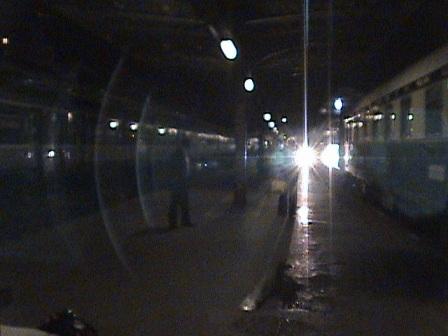
My thoughts turn back to the present as we race out of Zurich, treated to an almost psychedelic tableau as railway lights shoot brilliant beams into the cabin and work trains come and go like ghosts in the night. I'm also surprised -- though I shouldn't be here in these higher altitudes -- to see a light encrustation of hoarfrost covering the railway ties, glazing the stunted grass on the embankments and icing over the roofs of houses that border the tracks.
Though the night journey is one of the most magical aspects of traveling on the Venice-Simplon Orient-Express it's ironically also the one part of the trip that most passengers miss. Fast asleep in the comfort of their cabins, they slumber, lulled by the gentle rocking of the vintage Pullman cars, sedated by the steady, hypnotic rhythms of train wheels clacking across iron rails. They're oblivious to a dreamworld that floats just outside their cabin windows, blind to a kaleidoscopic display of whirling phantasmagoria and wheeling ghost-lights, of whistle-stop towns that loom in monochrome out of gray mists and the snoring maw of night, towns seemingly as dead to the world as the somnolent passengers, and unconscious of the exquisitely selfish pleasures of prowling the silent, untenanted corridors of the Orient-Express from end to end and having the entire train to oneself. Ah, think I -- dream on, you sleepers! Your unsuspected loss is my delectable gain!
As the train rumbles on through early darkness, the insomniac traveler's nocturnal vigil is rewarded by brief flashes of sometimes striking, even otherworldly imagery; the silent postage stamp-sized railway station at Chamberay with its small blue sign that looms into view for half a minute; the catenaries of glowing red lights strung from rural power lines that hang in black space like arabesques of crimson fire; the walls, windows and doors of shut-up shops in one town that we steal through; a blurred sheet of sudden brilliance and screaming steel as other night trains rush past us at dizzying velocity, lighting up the Stygian mists with a fierce, cold firefly light that flickers and is extinguished in seconds; the feel of the rocking floor beneath my feet as the train hurtles through darkness and swirling vortices of dense fog.
I feel like knocking on doors and shouting, "Hey, wake up. You’re missing all this." But I’m not crazy enough to do it. Besides, I’m too selfish. I want to have this all to myself.
7:31. An hour out of Zurich. It's beginning to get light. We're rolling at a moderate clip through dense Alpine forest. This is tall timber country, king pine country, the small village of Besse-sur-Issole showing off the first Helvetian architecture of the journey as cars with headlights punching holes through the dense fog stop at the railroad crossing to let us pass. The pea soup-gray fog still oppresses the landscape, and the hoarfrost I first noticed near Zurich-Allensee is still all over everything. The fog is incredibly dense in some places. It collects in the hollows of the terrain, accumulating and thickening into cottony patches.
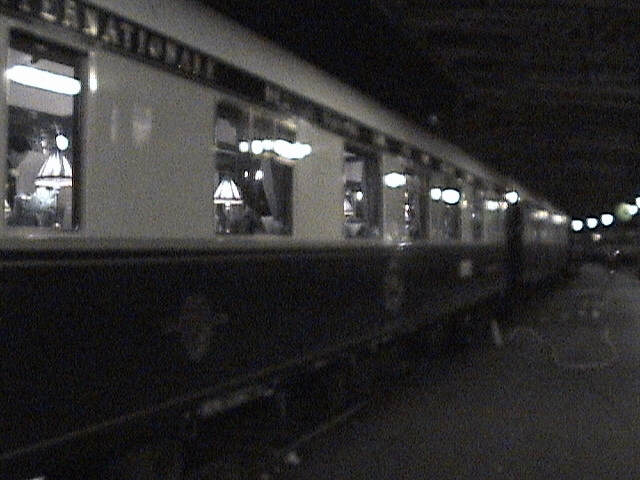 The
Orient-Express comes to a full halt every so often, waits, as if gathering
strength for a fresh sprint, then charges forward again at a flat-out run. And
always there’s the sneaky pleasure of being perhaps the only one awake at this
hour, having this Shangri-la on wheels all to oneself -- spoils to a victor over
a tired brain and the body's demands for repose in one of the double
compartment’s comfortable bunks. I’ve been wide awake for at least the last
thirty-six hours, but it’s been worth it.
The
Orient-Express comes to a full halt every so often, waits, as if gathering
strength for a fresh sprint, then charges forward again at a flat-out run. And
always there’s the sneaky pleasure of being perhaps the only one awake at this
hour, having this Shangri-la on wheels all to oneself -- spoils to a victor over
a tired brain and the body's demands for repose in one of the double
compartment’s comfortable bunks. I’ve been wide awake for at least the last
thirty-six hours, but it’s been worth it.
7:47 AM. It would probably be fully light by now except for the
persistence of the heavy fog. We've been rolling through high Alpine
countryside, passing quaint Alpine villages, sometimes paralleling the winding
Gotthard motorway, other times ducking behind low hills and railway embankments
from which the frost of earlier morning has largely -- but not completely --
melted off. The chill in the cabin air has now been pleasantly alleviated by
warmth rising from the cabin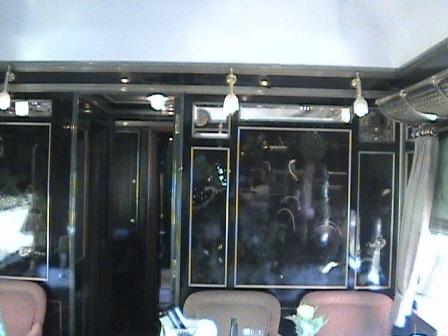 ’s vintage brass ventilation
register (or small radiator) located directly beneath the window -- in our case,
beneath both windows -- of the dual compartment. Mario earlier demonstrated how
he stokes the car’s wood-burning furnace at the front of the car. Some things
should never change, and the old-fashioned furnace that delightfully and
efficiently warms the cabins is one of them.
’s vintage brass ventilation
register (or small radiator) located directly beneath the window -- in our case,
beneath both windows -- of the dual compartment. Mario earlier demonstrated how
he stokes the car’s wood-burning furnace at the front of the car. Some things
should never change, and the old-fashioned furnace that delightfully and
efficiently warms the cabins is one of them.
7:53 AM. We've broken through to a magnificent highland vista as we skirt the hills above Lake Lucerne, known locally as the Vierwaldstättersee, literally "Lake of the Four Forest Cantons." Early commuter vehicle traffic flows at a relaxed pace along the Gotthard motorway that stretches along the vast lake, whose full beauty lies shrouded by banks of tenacious morning fog, but the striking colors of autumn foliage redeem the monochromatic canvas with gorgeous splashes of brilliant reds, fiery yellows and tawny browns. Then -- on the eastern shore of the lake -- the gray blanket suddenly lifts to reveal a glimpse of lakeside villas set amid the high timber. A moment or two later we're swallowed up by a mountain tunnel.
7:58. More first glimpses of what my memory identifies and my map confirms as the Berner Alps as we come barreling out of the tunnel's far end. The best is yet to come, as these are mere foothills to the true high Alpine country, which we’ll be in the midst of in a little while.
8:32. Have had to stop watching the scenery to dress for a few early get-togethers with passengers and train personnel. Just caught a glimpse of a lorry passing us on the highway adjacent to the tracks with a family of three sitting in the cab. A towheaded Swiss boy looked my way and flashed me a wide, toothy grin. I waved to him as the lorry shot ahead and out of sight.
8:47. More views of craggy Alpine foothills as the train wheels by the town of Erstfeld -- "First Field." High evergreens mingled with trees showing off blazing fall colors flank the hillsides. Above forested slopes tower craggy mountain giants, fringed with stands of tall pine, almost shaggily leonine in collective appearance, and these are bare, jagged, majestic arrow thrusts at a sky now clear and cloudless. No traces of fog remain. The jagged sawtooth peaks glow brilliantly, throwing back the first cold rays of the just risen-sun. We pass the town of Gurtnellen. It's a picturesque Swiss village with a cheerful gasthaus visible from the train. We’re in the vicinity of the Gotthard Pass which experienced severe landslides the previous June. This and other Alpine landslides like it account for why the Orient-Express has been rerouted for the season.
9:30. We’re now near Lugano, getting closer to the northern part of Italy.
I'm seated in the third dining car (the train has three). I'm to breakfast with
our trainmaster so I'm jacketed,
 but since it’s informal
I'm not wearing a tie. Fortunately writers can get away with things like that.
We're traversing Switzerland from north to south, but I’ve been warned that by
noon the good views will be over -- the longer Arlberg route gets striking
vistas till early afternoon, say till around 2:30, but due to winter avalanches
the Arlberg Pass is also closed now and won’t reopen till next spring.
but since it’s informal
I'm not wearing a tie. Fortunately writers can get away with things like that.
We're traversing Switzerland from north to south, but I’ve been warned that by
noon the good views will be over -- the longer Arlberg route gets striking
vistas till early afternoon, say till around 2:30, but due to winter avalanches
the Arlberg Pass is also closed now and won’t reopen till next spring.
3:29 PM. Switzerland is now behind us. We crossed the Italian border earlier this afternoon. As we now roll into Brescia, the houses are multistory, of poured concrete, colored ochre, brown, deep red, buff salmon, a palette of earth tones, balconied, trellised with plants spilling chaotically from planters, hung with laundry, graced with gardens. The sounds of a busy rail yard crash in from the two windows of the double cabin along with fresh and unusually warm air for late October. Again I'm struck by how springlike this autumn day has been, especially in contrast to the cold of the preceding night.
Now we coast, we sneak, we seemingly steal on tiptoes through the city's back-alleys like a pussyfooting thief, our presence stealthy, though not stealthy enough to escape the attention of friendly workmen who pause from their labors to wave at us as the Orient-Express rolls past them.
Towering behind Brescia is a tall, broad mountainside, lush with plane and olive trees. It's also crisscrossed with desultory villas. Nothing new here: the city has been a favorite retreat of Italians since Roman times. Now and then small vineyards spring into view; the grapes have all been harvested weeks before, but I muse that they'd have almost been close enough to pick had it been September, and had I been able to extend my hand far enough beyond the windows of the slow-rolling train to pluck a bunch with my fingers.
Now we swing around a bend in the tracks and see the south face of the broad mountain rising behind Brescia. It's an uglier turn to this nether face which bears the scars of strip-mining, with squat factory blockhouses clustered at its foot instead of the fashionable garden apartment condos we passed earlier. A Doctor Jeckyll and Mr. Hyde of a mountain if there ever was one, is this seamy Sinai rising behind Brescia.
Now a passing freight train, flatcar after flatcar carrying hoppers laden with bituminous coal from the south, clanks and rattles by us, and we’ve arrived at Brescia's industrial outskirts. We pick up speed as if eager to depart for less saturnine demesnes. Finally we break free into the Italian countryside again, clattering pell-mell past sprawling commercial vineyards that have been harvested clear down to the tawny stubble.
3:42. Romano: A somewhat seedy station. It's one squat maintenance shed defaced by white graffiti, but still classically Italian in a certain way and still picturesque in its own right. Another train, an Italian TrenItalia local, pale green and many-windowed, pulls in suddenly, disgorging streams of passengers. They’re mostly kids returning home from school. Many of them look at us, feigning disinterest but secretly titillated at having caught a glimpse of the Orient-Express far from its beaten path.
Our diesel locomotive toots its horn -- everything's suddenly a blur of motion as we whip along, but I glimpse the ancient crenellations of a Renaissance castle at the crest of a distant hilltop as if to remind me that speed is no match for timeless beauty. More vineyards here -- and a surprise: A winter crop of wine grapes has been planted, kept warm under heat-retaining black plastic netting in order to maximize growth. As we pass close, the plants seem lush, the vegetation rich and dark. It will be a bountiful harvest I’m sure. Maybe I’ll return for a bottle or two.
4:02. Outside Verona (Porta Nuova), the sprawling Autogerma facility, Volkswagen’s main industrial center for Italy, filled with hundreds of parked autos, is visible to the right on the corridor-side of the compartment.
As I stand in my bare feet on the corridor carpet, the floor vibrates under the soles of my shoes. Only about ten feet ahead of this first car of the VSOE, the yellow FN locomotive that’s pulled us halfway across Italy, suddenly howls at an oncoming express freight barreling past at breakneck speed.
Mario is lingering in the sunlit corridor outside the double cabin. He puckishly suggests that I've gained weight since he last saw me, which was about fifteen minutes ago.
"You look fat, but that's all right, Mr. Alexander. Everybody gets fat."
"What about you, Mario, you're not fat."
"I'm working, I don't eat what you eat."
"I’m working too. Remember, I’m a writer so even when I walk around appearing to do absolutely nothing, I’m still hard at work. Besides, I can slip you some French cuisine and you can put on some pounds too. Fair is fair."
"Oh, you are kidding me again, Mr. Alexander," Mario says after a moment’s reflection.
"I told you to call me Dave. Consider that an order."
"Yes, okay -- Mr. Alexander."
I give up, but before I go Mario has another story to tell me. He’s just remembered something funny that happened on another VSOE run, years before....
4:14. The afternoon wears on.
Again we steal through Italian back alleys, these of Verona -- we even see a few bourgeois ladies and gentlemen of Verona lounging on the rear balconies of split-level condos, the kind they’d call "garden apartments" on NYC's Queens Boulevard. Laundry hangs from balconies here with an insouciance only native Italians seem to know.
It's somehow startling for a Brooklyn boy -- even a well-traveled one --
having grown up to the syncopated rumble of the nearby IND elevated subway line,
to contemplate these citizens gifted with a cons tant glimpse of the
VSOE -- but then I recall that this isn’t quite the case -- this is a rare treat
for them too -- one owing to chance and the bold caprices of unrepentant nature,
not to human design. I remind myself that this is the last run of the season,
and that the Orient-Express is as much a stranger to these parts as I am.
tant glimpse of the
VSOE -- but then I recall that this isn’t quite the case -- this is a rare treat
for them too -- one owing to chance and the bold caprices of unrepentant nature,
not to human design. I remind myself that this is the last run of the season,
and that the Orient-Express is as much a stranger to these parts as I am.
5:06. Vicenza -- the last big town on the iron road to Venice. This red-roofed city is quickly giving way to capacious fields of tawny stubble like the ones we’ve passed through earlier outside Brescia and Verona -- evidence of a bountiful grape harvest this year. Again, a back-alley sneak for the Orient-Express through the outskirts of Vicenza.
The second and final lunch sitting is served as we tilt southward between Vicenza and Padova. The dining car (the bar car was originally a dining car, I’ve been reminded) is already beginning to fill up.
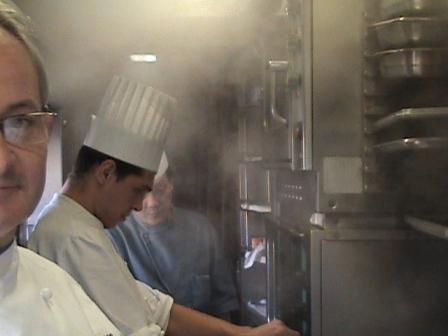
Our Chef de Cuisine, Christian Brodiguel, has prepared his special foi gras for me, a great honor, because it shows I’ve found favor in his eyes, which is always a good relationship to have with the person who prepares your food. I eat the foi gras, speeding its way down to my stomach with a well-rounded, nicely chilled Sancerre -- a wine of authority, as Papa would surely have said -- as we bump along passing a huge soccer stadium rising like a giant just outside Verona. A fast-paced game is now in progress.
I ask our Maitre D' to extend my compliments to our Chef de Cuisine, and am rewarded by a second helping of foi gras which I devour faster than the first and chase with more cold Sancerre.
At 5:24 we pull into Padova, passing perpendicular to the city's main avenue which the railway line cuts straight across at a clean right angle. It’s great to look down broad avenues while sipping crisp white French wine and watching pedestrians and cars roll past practically at eye-level. It’s almost like flying in a dream, in fact. I’ve ridden the Orient-Express before but I’ve never had this experience, nor such plenteous and distinguished servings of the fruit of the vine to lend wings to my Muse. This has already been a trip to remember, but there’s more to come.
6:10. Venice! The Orient-Express has stopped at the Santa Lucia rail terminal. Our baggage is waiting on the platform. It’s already dark as we leave the station by the side exit -- much simpler than contending with the stairs at the front while carrying luggage, by the way -- and emerge onto the Riva degli Schiavoni, the six hundred year-old paved embankment along the Bacino di San Marco whose name still attests to the ancient trade concessions that made Venice rich; in this case the reference is to the Yugoslavian merchants from Istria, across the Adriatic.
It’s the night before All Saints Day and the crowds are unbelievable for this time of year. Venice is literally bulging at the seams. Having found out at the last minute that there would be no vacancies I was lucky to find a hotel room for the first of our two nights in Venice at the humble Acqua Alta, a two-star hotel with little to boast of except that it’s a short walk from the station. *
11:20 PM: The other good part of lodging at the Acqua Alta is that mosquitoes and boring non-cable TV have driven us out into the Venetian night despite our being worn out from our journey. The problem is these madding crowds. It’s impossible to escape them. I’m beginning to think that there’s no way I can ever outrun the curse of Venice that’s afflicted me ever since my first visit a long time ago. She’s bitched me again, Venice has! No matter how well I plan, every time I come back to Venice something new goes wrong. I console myself that I’m not alone, otherwise my anthology Death and Venice would never have had a single contributor besides myself. I’ve got to face facts -- there’s just something about Venice that tries to cheat you blind.
Be that as it may I’m determined to enjoy my brief stay in Venice no matter what. It’s my only way of getting even. We’ve been alternately walking and riding the vaporetti for the last several hours. The Venetian fog and dinner at Harry’s Bar helped -- to mangle an old movie line -- take the sting out of Venice’s being occupied by a tourist army. Before returning to the Acqua Alta for the night I check my email at a nearby Internet cafe. What would Thomas Mann have made of that, I wonder?
12:00 PM. It’s the following day and I’ve checked into the Ca' Diamanteri,
a comfortable three-star hotel a dozen vaporetto stops away in the Dorsoduro
district where, with no compromises possible for a second night either at the
Acqua Alta or anywhere else in the vicinity, I've been lucky to find a vacancy
for one night. At least now I’m back in my old haunts, and walking again amid
familiar cobbled alleys I’m reminded of other stays in Venice, and how I love
this city. Back in my old Venetian haunts and ensconced in a cheerful room
overlooking a sunny campo (the Venetian term for piazza), I begin
to cheer up again. I reflect on how much Venice has changed in relatively few
years, even to its having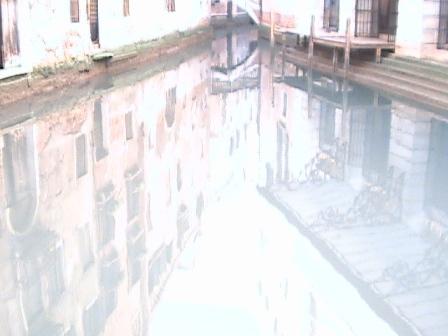 picked
up the American obsession for interior renovation. Once upon a time few
self-respecting Venetian interiors (or, for that matter, exteriors, as a perusal
of old prints confirms) weren’t characteristically seedy looking, and peeling
paint and moldy plaster were trappings of charm instead of eyesores. Not any
more. The time-honored scuzz look is sadly a thing of the past. Venice today
sports a glitzy makeover and a lot of new wall paint.
picked
up the American obsession for interior renovation. Once upon a time few
self-respecting Venetian interiors (or, for that matter, exteriors, as a perusal
of old prints confirms) weren’t characteristically seedy looking, and peeling
paint and moldy plaster were trappings of charm instead of eyesores. Not any
more. The time-honored scuzz look is sadly a thing of the past. Venice today
sports a glitzy makeover and a lot of new wall paint.
10:30 PM. We're winding up our second and final night in Venice before re-embarking on the Orient-Express and traveling on to Rome. Have spent the day with dog-eared Michelin guide and digital camera in hand. Since the tourist army is still in occupation there’s no need to try to blend in with the locals. The only drawback is that it makes bargaining for a gondola ride somewhat harder. The gondoliers no doubt realize that today might spell their last chance to price-gouge the tourists and are inflating their rates with a typically Venetian vengeance.
A little perseverance -- and a reminder to one intrepid fellow in a striped costume that he’s suggesting I pay him almost one hundred U.S. dollars to traverse the distance of a city block -- pays off and I’ve hired a gondolier who not only sings but plays a small, accordion-like instrument, to ferry me at a relaxed pace about the moonlit canals.
Hours later, after I’ve broken into lusty song a few times myself, startling some of the tourists with hearty if off-key renditions of "Purple Haze," "Piece of My Heart," "Satisfaction," and other classic rock standards, my new friend -- and gondolier-in-waiting anent my next trip to Venice -- Benito, deposits me back at my embarkation point near a humpbacked stone bridge a short distance from the Ca' Diamanteri. It’s still early enough to grab a bite to eat but late enough so that the only place to grab it is a local bar-cum-restaurant a few winding twists and turns away from the hotel. I return to my room to find that a strolling violinist has taken up a position just below its campo-facing window. Eager to retire, I run cold water from the bathroom tap into a plastic cup thoughtfully provided by the management for a purpose other than dashing liquid vengefully onto the head of the street busker below my window. Fortunately, as I open the shutters and lean out into the fragrant Venetian night, the music stops. I sip the water as I watch him pack up his fiddle and go on his way.
5:00 AM. We got a wake-up call from the front desk of the Ca' Diamanteri. I was already up, calculating correct time by my digital watch, still set to New York time. I’d mentally added five hours in the UK, then six in Italy, but I now realized that I’d need to add seven because of the transition from standard time to daylight savings time that would take effect at midnight tonight, further complicating the demands on my already overburdened and congenitally number-challenged brain.
But even had I forgotten about daylight savings time, no matter, for the ever-vigilant hotel staff would have saved the day -- or a least would have tried to.
The desk man at the Ca' Diamanteri handed me a little card reading, "Time to go back today."
I studied this pasteboard square, trying to decipher its meaning -- where was I supposed to go back to, exactly? Brooklyn? The Acqua Alta? I finally gave up and asked him to tell me what it meant.
"Time changes tonight. Clock goes back."
So now I had to calculate a new time change.
"When does it go back?" I asked. "Midnight?"
He shook his head and replied, "Around two or three in the morning."
Now I was more perplexed than ever. Could it be that here, unlike in the
United States, daylight savings time took effect not at midnight as I’d assumed
as an article of faith all my life, but at some indeterminate period in the wee
hours of the morning? Could Italian daylight savings time be fuzzy time? A
changeover that was a p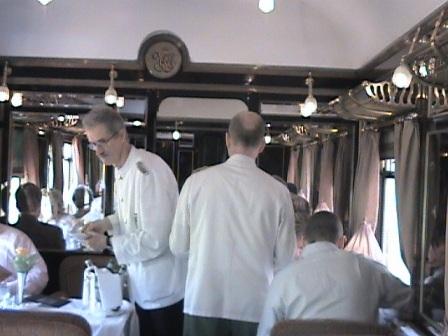 erpetual mystery?
I asked him again and got the same reply. "Around two in the morning, maybe three o’clock." He made a back and forth hand gesture which clarified nothing.
He couldn’t be more precise than that, but he assured us it wouldn’t effect our plans to take the vaporetto back to Santa Lucia Station at seven that morning. That was the main thing to remember. We’d have an extra hour, in fact, he claimed, although since we’d be gone from Venice well before three the next morning, I didn’t see how that was possible, even here.
7:30 AM. After an unhurried breakfast in the hotel’s pleasant dining room it was back to the vaporetto stop. It was a Tuesday morning and the waterbus was crowded, but it couldn’t be helped. My position near the front of the vaporetto yielded the unexpected opportunity to practice my conversational Italian with the vaporetto driver until the rush hour throng thinned enough for some seats to open up in the passenger compartment just aft of the bow. I took a seat and watched Venice roll past the windows as the vaporetto plowed its steady course along the Grand Canal toward Santa Lucia and the waiting Orient-Express.
10:01 AM. We’re back in our compartment aboard the Orient-Express again. We’re about a half hour out of Venice and rolling slowly through Padova, stopping only long enough for onlookers to gawk as we slide through yet another railway station. The skies are overcast. The on-again, off-again autumnal chill is back in the air. Clear skies shone intermittently upon our inbound trip, and it looks like we’ll have clouds again on the final leg of our journey that will deposit us later tonight at Ostiense Station in Rome. Our new cabin steward has already introduced himself. His name is Rubard. I’ve already made arrangements to have another talk with our trainmaster, who remains the same this trip.
Now the Orient-Express picks up speed. We’ve left Padova station behind us. A group of colorfully painted tour buses passes us on the autostrada adjoining the railway tracks. Passengers gape at me as, bare-chested, and wearing my gray ball cap that reads "Bubba’s Bar-B-Que," I make muscleman poses at them by the open cabin window.
Soon we’ve broken free of the autostrada and are back out in open country again. The train’s whizzing through flat grassland now, much of it farm fields lying fallow beneath the cloud-covered skies. My Bubba cap’s back in my baggage and I’m putting on my suit to meet our trainmaster. A knock on the door signals the appearance of Rubard who’s brought coffee, tea and pastries. Lunch is to be served in the first dining car this time, our steward reminds us. Would we like the first or the second seating? I opt for the latter.
11:06: As I return from the bar car, after an hour’s pleasant conversation with our trainmaster, we’re passing rail yards stacked with containerized shipping outside Ferrara. The bar car had been empty when I arrived but began to fill up fast, especially with a piano player tickling the ivories.
"Play it, Sam," I told him, tugging on my earlobe. "You know the one I mean."
He looked at me quizzically. Then he began to play "As Time Goes By."
Just then the bartender appeared. He took a slip of paper out of his jacket pocket.
"Your bill, Mr. Alexander."
"The line should be 'Your winnings, Mr. Rick,'" I quipped, but signed it anyway.
Now we’re heading south by southwest, cutting on the diagonal across the upper part of the Italian boot. Our next major rail junction will be Bologna.
There is a new Maitre D' and new cabin stewards for this Venice-Rome portion of the journey, though many if not most of the passengers who first embarked in London are still with us. I recognize some new friends and stop to say hello and trade stories of our stays in Venice. Our trainmaster, the ever-congenial Bruno Janssens, is also circulating among the passengers. He’s not only affable and worldly but also has a knack for sure-footedly navigating the trains often rocky aisles and corridors. His acrobatic secret, he'd told me, is to tread lightly on the balls of the feet and stay with the momentum of the train. He makes it look easy.
11:15. The Express slows outside freight yards in the vicinity of Castelmaggiore. Sun now appearing as advertised, bringing out the green in fields of clover with huge steel electrical pylons growing where trees should rightfully have been. My companion had asked for the radiator to be turned on while I was gone. It's gotten chilly again. She’d ordered extra tea too. She told me our steward Rubard had asked if I wanted champagne; he’d told her he’d be back to ask me. Sure enough, there’s a knock on the door and soon there’s a bucket of iced Dom Perignon in our compartment.
The VSOE soon comes to a dead stop at Castelmaggiore, a small but very new-looking station surrounded by vineyard fields. The late October sky’s still overcast but there are patches of somewhat anemic sunlight dappling the green-and-mauve carpet of our double compartment. Time to pop the cork on that bottle of bubbly.
11:28. Rolling slow amidst the highway cloverleaves, fields and multistory
condominiums crowding the outskirts of Bologna. Ocher building walls, clothes
lines everywhere -- fluttering and waving in the breeze. Wine-colored clay
roofs. Pink walls. Dark green wooden shutters. Yellow walls. Salmon walls and
mauve shutters. An API gas station marks our passage deeper into the city’s
heart. Apartment blocks appear out of the late morning mists, dominating the
middle distance, but hard by the tracks there are smaller, single-family homes
flaunting well-tended backyard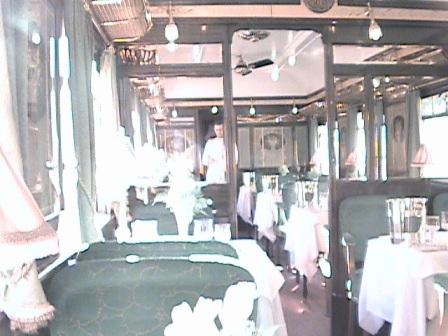 gardens and graced with
neat black ironwork verandas more often than not draped haphazardly with the
matutinal laundry.
gardens and graced with
neat black ironwork verandas more often than not draped haphazardly with the
matutinal laundry.
Bologna’s back-streets sweep past the train -- not much traffic yet, as, after all, this is Sunday morning, and we catch glimpses of the blocky buildings clustered at the center of town, some -- like twin sliver high-rise towers mushrooming up beside an untenanted soccer field -- high enough to intimidate even New York buildings.
Twenty minutes later we’ve left the city behind and are back in the Tuscan countryside, picking up speed as we barrel though increasingly steep hill country with tantalizing glimpses of mountaintop villas fringed by olive and plane trees, cutting like a dagger down the Italian boot as we roll toward our next stop, Florence.
We’re a blur of motion now. Chuting-the-chute, looping the loop. A demon of speed, hellbent for leather. Daring all, we fly through tunnels, then burst out again into sudden, dazzling brightness. Now we're truly an express, an express with a vengeance.
Dark.
Light.
Day into night.
It’s sensational, this playing tag with a Minotaur's maze of mountain tunnels. But there are also breathtaking views in between. Rolling fields, emerald green in scattered sun, stretch forth on all sides, fringed by craggy hills bursting with trees in full, riotous glory of magnificent fall foliage. An arched steel trestle bridge with a few meandering lanes of traffic creeping lazily across it, spans a high valley through the center of which rolls a rambling ribbon of river, blue as Pittsburgh steel.
Beautiful country villas dot the tawny hillsides. How
fortunate to have such a picturesque vista spread at one’s feet year-round! A
tall church steeple, perched high on a distant hill crest, thrust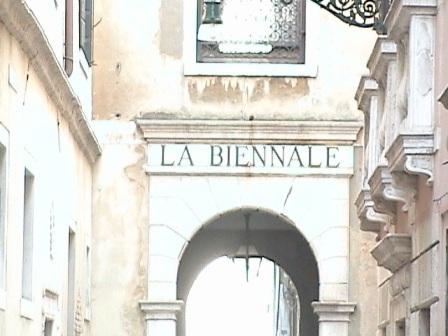 s skyward, framed in stark
silhouette against a knife-sharp, crystal-clear sky of limpid blue. Now we pass
another soccer field where a game’s apparently just begun. In the distance,
another high trestle bridge spans two hill crests daubed in exuberant fall
colors, traffic crawling across its arched span like so many beetles over a
toppled log.
s skyward, framed in stark
silhouette against a knife-sharp, crystal-clear sky of limpid blue. Now we pass
another soccer field where a game’s apparently just begun. In the distance,
another high trestle bridge spans two hill crests daubed in exuberant fall
colors, traffic crawling across its arched span like so many beetles over a
toppled log.
Once again light trades places with darkness and darkness explodes into dazzling brilliance as we thread the needle in and out of a maze of mountain tunnels. We’re racing along, full-tilt, full-throttle, no slowing down, not yet, maybe never. The wind blows hard and cold through the corridor, the floor of the train is rocking and bouncing, teetering and seesawing beneath my feet, and I realize I’m feeling more alive than I’ve felt in a long time.
On impulse I check my wrist watch. I’m relieved to discover that there are hours yet before our arrival at Rome-Ostiense. I’m looking forward to seeing Rome again after a too-long absence, but I want to savor every last minute of this trip on the Orient-Express, especially because this roundabout route, with its quirky twists and turns, and its sometimes startling and unique panoramas, may never be traveled again -- ever.
We roar into yet another mountain tunnel and for just a moment I glimpse something. An apparition, eerily spectral. Then, in the blink of an eye, it’s gone. As quickly as that.
No, it couldn’t be, I tell myself. It’s just the effects of lack of sleep, and the exhilaration of the journey, that made me see things that weren't really there.
As we bolt helter-skelter from the dark confines of the tunnel into the cold brightness of the autumn morning I suddenly feel a presence behind me. I spin around, but it’s just Rubard coming by to inquire if I need anything, and to remind me with a smile that lunch will soon be served.
All text and photographs copyright (C) 2012 David Alexander. All rights reserved.
*The name of this and a few other establishments and locations have been changed for various reasons, including the possibility of my needing a Venetian hotel on short notice in future.